He who is born in imagination discovers the latent forces of Nature.… Besides the stars that are established, there is yet another—Imagination—that begets a new star and a new heaven.
-Paracelsus
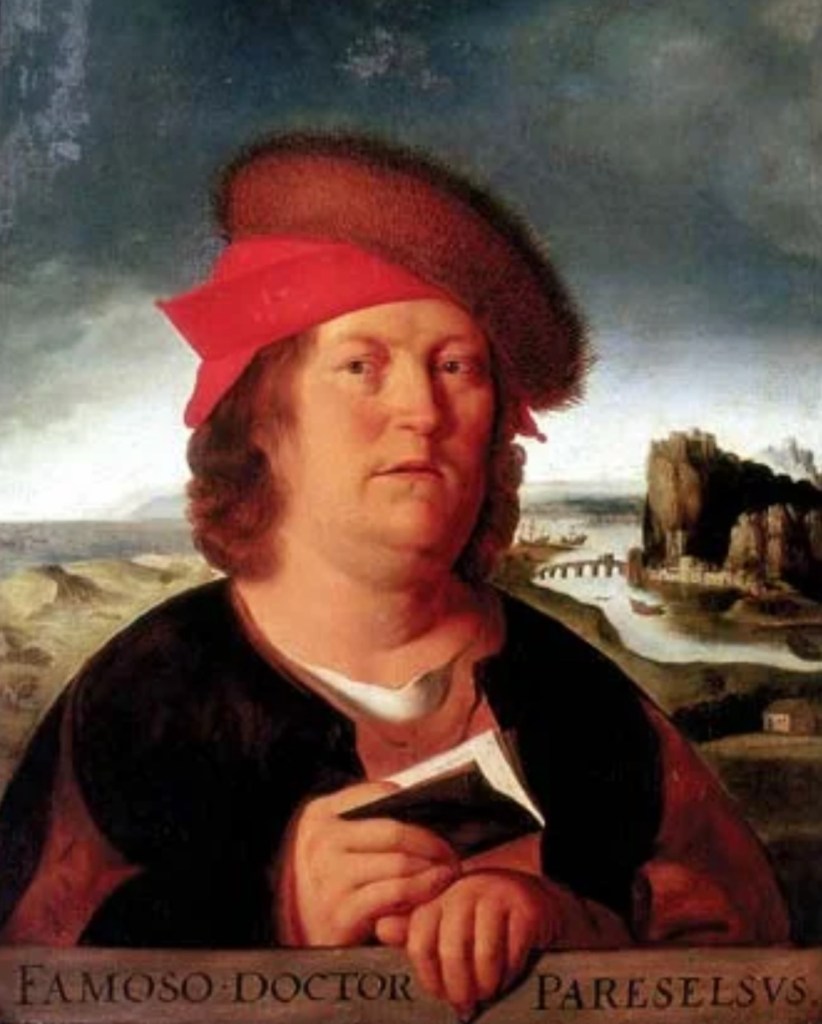
Paracelsus (1493–1541) was a Swiss physician, alchemist, and philosopher, he revolutionized the path of human thought.
© Photos.com/Jupiterimages
Paracelsus’ real name was Philippus Aureolus Theophrastus Bombastus von Hohenheim.
He took the name Paracelsus to imply his intellectual superiority to the Roman physician Celsus.
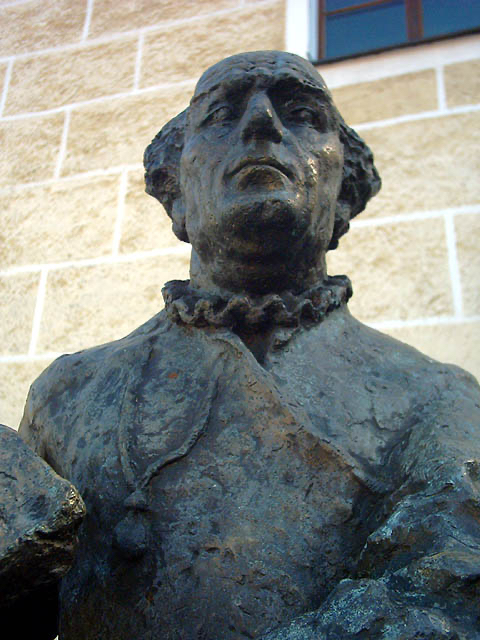
Paracelsus was a deeply unconventional thinker, to say the least.
He blend medicine, alchemy, astrology, and mysticism, defying the rigid doctrines of his time.
Paracelsus saw alchemy as a transformative science applied to the body. He introduced the concept of iatrochemistry—the use of chemicals and minerals in medicine—laying the foundation for pharmacology.
PARACELSUS HELD UP TWO MIDDLE FINGERS TO THE ESTABLISHMENT
In His Words:
“The universities do not teach all things,”…“so a doctor must seek out old wives, gipsies, sorcerers, wandering tribes, old robbers, and such outlaws and take lessons from them. A doctor must be a traveller.…Knowledge is experience.”
Paracelsus knew that the crude language of the innkeeper, the barber, and the teamster had more real dignity and common sense than the dry Scholasticism of Aristotle, Galen of Pergamum, and Avicenna.
He knew nature provides signs indicating the medicinal properties of plants and minerals. He taught that God encoded healing knowledge within all creation.
PARACELSUS THE ASTROLOGER
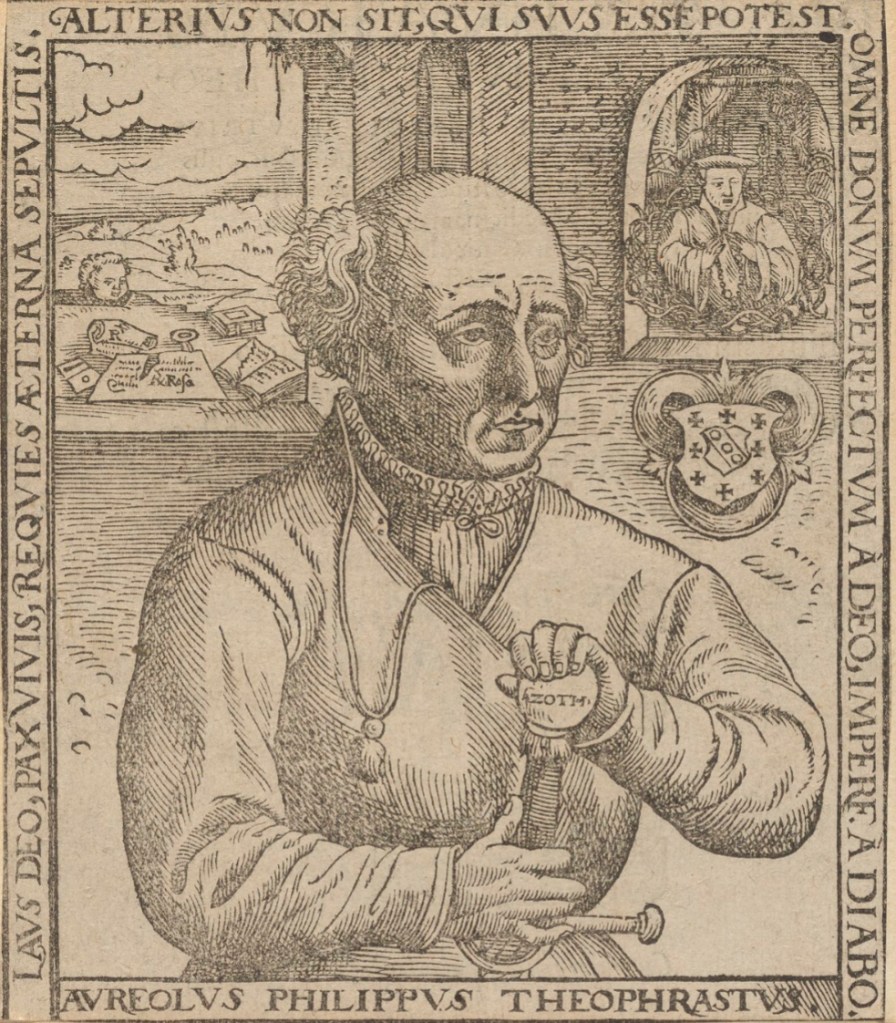
Paracelsus devoted several sections in his writings to the construction of astrological talismans for curing disease.
He also invented an alphabet called the Alphabet of the Magi, for engraving angelic names upon talismans.
Paracelsus mostly rejected the philosophies of Aristotle and Galen.
TRINITY– 3 PRIMES (TRIA PRIMA):
In his alchemical system, everything in existence was composed of three fundamental substances:
• Sulfur (soul, combustibility, volatility)
• Mercury (spirit, fluidity, changeability)
• Salt (body, solidity, permanence)
This added to the four-element theory (earth, water, fire, air) influencing tradition.
Holistic Healing
He rejected the academic medical establishment of his time, advocating for an approach based on observation, experience, and the interplay between the spiritual and physical realms.
As Above, So Below
Paracelsus saw the human body as a microcosm reflecting the macrocosm of the universe.
He integrated astrology into his medical practice, believing celestial bodies influenced human bodies.
Rejection of Authority
He publicly burned traditional medical texts, defying Galenic and Aristotelian traditions.
His belief that knowledge came from nature and direct experience rather than academic institutions made him a heretic in the eyes of many so called ‘professionals’.
Legacy & Influence
Paracelsus’ ideas bridged the gap between medieval superstition and modern science.
He anticipated concepts in chemistry, toxicology (“the dose makes the poison”), and psychosomatic medicine.
His work heavily influenced later alchemists, Rosicrucians, Hermeticists, and esoteric practitioners, while also shaping the future of established ‘medicine’.
Paracelsus was a true archetypal Fool—ridiculed in his time but later recognized as a pioneer.
His fusion of alchemy, medicine, and spirituality makes him a cornerstone figure in both scientific and mystical domains.
 Resource Alchemy
Leave a comment